 Skip to content

 Josey Tees & Hats
 Selektor Record Bags
 Vintage Apparel
 Josey Exclusives
 Skylark Soul Co.
  Turntables
 Turntable Accessories
 Speakers
 Headphones
 Vintage Funko Pop!
 Vintage Posters
 Handmade By Robots
 Vintage Pins
 Toys
Toys Games
Games Posters
 Coloring Books
 Sticker Sets


Regular price $39.99
 Earn rewards points with purchase of this item.
Learn more about our rewards program.
Earn rewards points with purchase of this item.
Learn more about our rewards program.
FORMAT: New CD • UPC: 198028199728
GENRE: Classical Artists • RECORD LABEL: Sony Masterworks
RELEASE DATE: 12/06/24

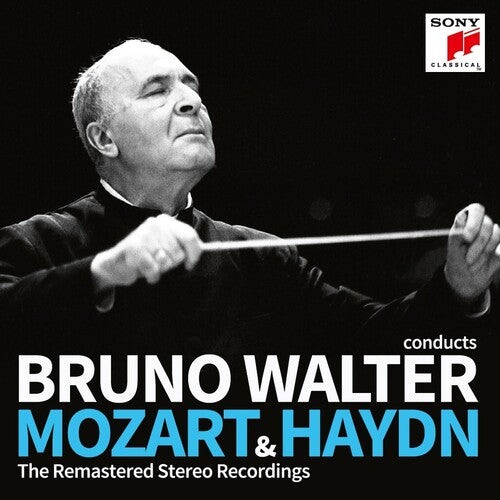
Bruno Walter - Bruno Walter Conducts Mozart & HaydnRemastered Stereo Recordings (CD)
$39.99
Bruno Walter - Bruno Walter Conducts Mozart & HaydnRemastered Stereo Recordings (CD)
DESCRIPTION
Details: In the days of the great conductors, many were appreciated, admired, even idolized. Bruno Walter was loved. He was as severe in rehearsal, as demanding of his musicians, as any conductor, but he projected an air of beneficence; it emerged so strongly in his personality that his rather tough-looking visage seemed to glow. All of that also came across - still comes across - in his performances, the more so as he aged. In his glory days with the New York Philharmonic, in the 1940s and 50s, he was considered the antithesis of Arturo Toscanini, but comparison of their recordings often yields more similarities than differences. They highly admired each other; Toscanini privately admitting that Walter may have found something more in Beethoven's Ninth ("perhaps he is right..."). As they aged, Toscanini sped up, adding ever-greater tension to his performances; Walter slowed down, radiating ever-greater love. This was particularly apparent in his Mozart. The German Romantic classics, Beethoven, Brahms, and Mahler, had been central to his middle years, but his life-long devotion to Mozart grew in his "post-retirement" days. Walter had retired in 1958, with final New York Philharmonic performances of Bruckner's Ninth and Mahler's Second (too impoverished to attend both, I chose Bruckner, after much soul-searching). The Mahler and a March 1958 Schubert "Unfinished" were to be his last Philharmonic recordings and his only two stereo ones, but in 1960 he would return to conduct and record Das Lied von der Erde. When he retired to California, Columbia Records executives tried to convince him that stereo would obsolete his monaural recordings and blunt his place in musical history. They offered him a pick-up orchestra, to be called the Columbia Symphony. The size of the orchestra varied with the repertoire, and it's personnel varied greatly from day to day. The "Prague" Symphony, recorded in a single four-hour session, was typical for these 18th-century works: There were 34 players, the strings, 14 violins, 4 violas, 3 cellos, 2 double basses. The concertmaster was Israel Baker, but all the others section leaders were first-desk players of the Los Angeles Philharmonic. The rest were drawn from the inexhaustible supply of retired musicians in Hollywood, many of whom were playing for movie studios. From 1958 to 1961, Walter recorded 55 works in Hollywood's American Legion Auditorium, where the reverberant acoustic supported and enhanced his glowing performances. Only the chorale finale of Beethoven's Ninth proved unsatisfactory, so Walter made one more trip to New York, this time with an East Coast version of the Columbia Symphony and the Westminster Symphonic Choir. Walter's Mozart and Haydn are anything but historically informed practice. Yet they are so winning that only the direst curmudgeon might complain. Haydn requires a quick, dynamic wit that didn't align with Walter's musical personality. His two New York Philharmonic Haydn symphonies (Nos. 95 and 102) are closer to ideal than these two (Nos. 88 and 100) from Hollywood. Still, they all make wonderful listening, for Walter's Haydn if not for Haydn's. His New York Mozart symphonies, recorded late in the 1950s, are close to these Hollywood efforts, the New York orchestra a touch more well-integrated. -James H. North
TRACK LIST
SHIPPING & RETURNS
SHIPPING
- In-stock items generally ship within 24 Hours
- Free shipping on orders over $75.
- International delivery time - 10-14 business days in most cases
- Easy 30 days returns and exchanges
RETURNS
If there is an issue product you can return it within 30 days. To start a return, please fill out our RETURN REQUEST FORM.
Recommended
Recently Viewed
Liner Notes

Knowledge Dropped, Lessons Taught: Mixing It Up With DJ EZ Eddie D
- by Luke Sardello

Cool by Design: 10 of the Best Reid Miles Blue Note Album Covers
- by Luke Sardello

The Year of Y'allternative
- by Morgan Learn

Yoshimi Battles the AI Music Robots
- by Morgan Learn

Why Are We Still Buying Deftones Records In 2024?
- by Morgan Learn

Midwest Royalty, Chappell Roan’s Rise To Fame
- by Morgan Learn

Digging Deeper In the Bins
- by Morgan Learn

Interview With An Outlaw, Angel White
- by Morgan Learn